Author: Eparaima Wild

Ashes to Ashland: Reverend George Gordon and His Crime Against Inhumanity

When discussing the most well-known criminals of 19th-century Ashland County, the names that come to mind are Charles Steingraver, George Horn, and Henry Gribbon. The crimes we tend to think of as most notable are murder, theft, and the like. There is one criminal in the county’s history who ought to be lauded as a hero, not for overcoming his criminal past, but for his unshaking determination to continue his life as an outlaw. This criminal was known by the name of Reverend George Gordon.

George Gordon was born in 1806 in Washington County, PA.[1] He was the oldest of five children with two younger brothers and two younger sisters. He spent much of his life there, and in 1837 he married Ann Finney of Holmes County, OH – the sister of Reverend John Finney. In 1851 he and his brother Joseph were among the first preachers of the Free Presbyterian Church. Little did he know at the time, but this would be considered one of his first public steps toward criminality. [2]

By 1860 he had been living in Iberia in Morrow County for some time, having been appointed as the first president of Iberia College.[3] The college was founded and operated by the Free Presbyterian Church, and was open to all regardless of race or gender. The Free Presbyterian Church was founded by members who left the Presbyterian Church due to its support of slavery. George and Joseph were both staunch abolitionists, dedicating much of their lives to the cause of ending the evil practice. While serving as president of Iberia College he regularly travelled to Ashland County to preach at the Free Presbyterian Church in Savannah.[4]

For 14 years, from 1850-64, the law of the land was the Fugitive Slave Act of 1850. The act made it legal to return “fugitive” freedom seekers to slavery even if they had escaped to states where slavery was illegal, in addition it mandated that citizens of the free states had to cooperate in the capture and return of the freedom seekers. Many slave catchers and those seeking wealth could kidnap freemen and those who escaped to freedom and return them to slavery. This act caused massive outrage in many anti-slavery communities and continued to stoke the flames of the slavery issue. On September 22, 1860, George Gordon became an outlaw.[5]

George Gordon’s own words can be found, unedited in the Wilber Siebert collection via OhioMemory:

“The thing occurred in the neighborhood of Iberia, Morrow County, Ohio. About dark, eight men came up on the train, rang the bell themselves, and stopped it about two miles below the station, got off, and divided into companies. One of these got to their place before any alarm was given, rushed into the house with their revolvers and bowie knives, seized their stray man, and fettered and bore him away. Another company invaded a second house, and searched it, but the alarm had been given, and the man or ‘chattel’ escaped. In the yard, they encountered two young colored men, students of Iberia College. Marshal Lowe (of Oberlin notoriety), seized one of them by the collar, probably mistaking him for the fugitive; the young man resisted, the Marshal fired his revolver twice, wounding him in the hand, and putting another bullet through his clothes. At this juncture, the other colored man struck with his gunbarrel, and a shot was fired as a signal, some distance off, upon which the redoubtable official put the steam to his pedals and escaped. The third company was still less fortunate. They broke into the dwelling of a Mr. James Hammond, did not find the fugitive, but reports says seized and bore off a watch instead. Mr. Hammond soon came in, learned what was done, took up a corn cutter, and followed them. He soon overtook and stopped them. After keeping them at bay a short time, he had others come to his assistance. The men were disarmed, taken to the woods and whipped, in the midst of their receiving a castigation I came up; was told they had received but little, and I stood by, consenting to their receiving from ten to fifteen lashes more. I then told the Deputy why he was chastised, the kind of men who did it, and that he had received but a small Instalment, a mere taste of what he was endeavoring to inflict on men as good as he was. He humbly confessed the charge, said he would go home, resign his office, and do so no more.”[6]

George was soon charged with “resisting process” and the court found him guilty and sentenced him to pay a fine of $300 in addition to $1,000-1,500 for the cost of prosecution (roughly $120,000 in 2026), and 6 months of “Close Confinement”.[7] Before he was taken into custody, George fled to Canada. He waited to turn himself in until the new Lincoln administration was in power. Once 1861 came and Lincoln was inaugurated, Gordon returned and turned himself in. He was incarcerated immediately and his many friends wrote the president for a petition requesting a pardon for Gordon’s actions. The pardon was granted. Despite a short time spent in prison his health began to rapidly deteriorate while imprisoned. George would never fully recover from prison and according to the death record he died on December 11, 1867, from Parotitis Open Abscess (cheek abscess).[8] George Gordon was a criminal, but in his mind, he only broke the law of man. He sacrificed his own freedom to ensure that it would not be denied to others.

[1] “Columbiana, Ohio, United States records,” images, FamilySearch (https://www.familysearch.org/ark:/61903/3:1:3QS7-89ZR-V9FV-D?view=explore: Feb 23, 2026), image 89 of 234; Ohio. County Court (Columbiana County).

Image Group Number: 004017361

[2] “Mercer, Pennsylvania, United States records,” images, FamilySearch (https://www.familysearch.org/ark:/61903/3:1:S3HT-6QGS-5QT?view=explore : Feb 23, 2026), image 70 of 807; United States. National Archives and Records Administration.

Image Group Number: 004205100. ; “Holmes, Ohio, United States records,” images, FamilySearch (https://www.familysearch.org/ark:/61903/3:1:939K-PXS1-NS?view=explore : Feb 23, 2026), image 255 of 658; Ohio. County Court (Holmes County).

Image Group Number: 004701450. ; Jolliffe, John. IN THE MATTER OF GEORGE GORDON’S PETITION FOR PARDON. Pamphlet, 1862. Pp-1-3.

[3] Ibid, pp 1

[4]Mrs, A.M. Buchanan. Mrs. A.M. Buchanan letter to Wilber Siebert, 1894, Mrs. A. M. Buchanan letter to Wilbur Siebert – Page 1 – Wilbur H. Siebert Underground Railroad Collection –

[5] United States Fugitive Slave Law. The Fugitive slave law. Hartford, Ct.?: s.n., 185-?. Hartford, 1850. Pdf. https://www.loc.gov/item/98101767/.”

[6] Gordon, Rev. George. George Gordon Underground Railroad activity, Nov. 1861. Manuscript, https://ohiomemory.org/digital/collection/siebert/id/5479/rec/4

[7] Gordon, pp. 1

[8] Columbiana Death Records 1867. Pp 86-87

Ashes to Ashland: Freedom and a Fracturing Faith

The Twisting Histories of the Savannah Presbyterian Churches

There is a unique experience that can be seen when travelling through America, regardless of state, location, or size; other than a fast-food chain and a gas station, the most constant building to find is a church. America is 11th in the number of churches per capita and has roughly 350,000 churches. In many cases, religion was a driving force behind the creation and unification of communities. In other cases, religion has served in the inverse role, pushing communities apart. Both were the case in Savannah, OH, during the mid-19th century. The prime case of this can be seen in the Presbyterian Church.

The Presbyterian church is a Calvinist denomination that originated in Scotland and has been prominent there for centuries, so much so that the national religion of Scotland, the Church of Scotland, is Presbyterian. This impacted Savannah as a large amount of its population in the 19th century was of Scottish or Irish descent (Ireland also has a relatively large population of Presbyterians; however, many of them are Scotch-Irish). The United States 1860 census lists Savannah as having roughly 1,200 residents. In this tiny community, there were at least 125 immigrants from Scotland or Ireland living there, and this does not include their children born here or any others who were born in the U.S. but have Scotch-Irish Descent. This means at least 10% population at minimum was Scottish or Irish. These immigrants and their families were almost entirely Presbyterian; however, this did not make them unified all the time.

The mid-19th century in America is the time in which, as Lincoln said, “we are engaged in a great civil war, testing whether that nation, or any nation so conceived and so dedicated, can long endure.”[2] Commonly the Civil War period is focused on the division seen in the territories, border states, and the North vs. South divide. The fight over slavey did not only divide on geographic lines, it also caused divides in families and communities, no matter how small. Savannah, Ohio, pulls both the threads of deep religious conviction and staunch beliefs regarding slavery into one strand that brought their community together and ripped it apart.

At one point in time, Savannah had four different Presbyterian churches, but how these four came to be and where they came to be is a story that walks alongside the struggles of the country itself. In the early days of its founding, Savannah had two Presbyterian churches, the Old School Presbyterian church (OSP) and the Associate Reformed Presbyterians (ARP). The OSP church first started meeting in the homes of different families until they eventually built a meeting house in 1835. Just before this, the ARP also began to form and worship in the same way, eventually moving to an outdoor tent used by other denominations as well, until the ARP built their own building in 1834. These two would walk alongside each other with different congregations, mostly separate due to the theological disputes between the sub-denominations to which they each belong.

The third church would come in around 1855 and is known as the Associate Presbyterian church, or Assoc. P. This church would have a smaller number of congregants than the other two; however, it remained strong for some time, and they met in the old ARP building. This church has existed since 1837; however, it did not officially form until ’55. The fourth and final church of the time was the Free Presbyterian Church, or Free Church, which was formed in 1851 by 13 members of the OSP who left over an argument that would shape each of the 4 churches in Savannah. This argument was, of course, slavery.

The OSP first began its heated arguments over slavery in the congregation in 1842. A meeting was called, and the two issues on the docket were “Is the Colonization Society worthy of the patronage of the American people?” and “Is the Anti-slavery Society worthy of the patronage of the American people?” Rev. Andrew Scott reported in his Sermon “The History of the Presbyterian Church of Savannah, Ohio: A Discourse,” which was later printed, that the debate lasted for 3 days. These debates tore the church apart and led to feuds that would never heal within their lifetime. [3] Out of these debates, their preacher, Mr. Shearer, announced he would resign due to the difference between himself and the congregation regarding these issues. After many attempts to have him stay, in the end, he left the church without a pastor. The church tried many times to gain a regular minister, but each minister either did not suit the abolitionists or did not suit the colonists. After months of effort they eventually settled on having a statement expressing their desires, it reads “Resolved, that we, the church of Clear Creek, feel it to be the duty of our Minister to preach against slavery as a sin on all suitable and proper occasions, and that he treat it in common with all other sins, just as the Bible treats it.”[4] This statement eventually led many of the Colonizers to leave the church. They were not the only ones to leave the church, however, as the years went on and the higher courts of the OSP were not as strong on slavery as many in Clear Creek would like, 13 members left and formed themselves into the Free Presbyterian Church. The OSP would not settle its internal arguments with the leaving of the 13 Free Church founders. Later in 1851, just a year after the split, they argued once again about slavery, concluding that most of the church was anti-slavery, but not a majority were abolitionists. The church agreed to not justify slavery regardless of source; however, it would not agree to only accept a minister who used his talents to exclude and denounce slavery and its supporters entirely. Many of the staunch abolitionists would find their way to the Free Church as time went on.

The Assoc. P Church, while only becoming official in 1855, was immediately embroiled in arguments over slavery. Not much is clear in written documents, other than one case of a member requesting a letter of dismissal due to his accusations that the church was pro slavery in practice but antislavery in profession, as it welcomed pro slavery advocates. The ARP Church had the same struggles with slavery as the other two (OSP & Assoc P), following almost the exact pattern that the OSP endured. The ARP church first began to split in 1851 when its preacher left after failing to put together a group to travel and settle in Oregon, in addition to slavery tensions boiling during the same time. Eventually, in 1854, 25 members left the ARP, and many joined the Free Church.

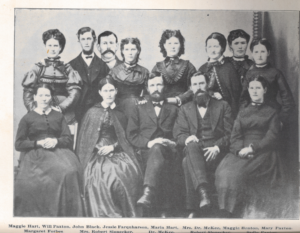
The Free Presbyterian church was made from members of all three churches who left in search of a church that would appropriately and accurately confront slavery as an unjustifiable and unacceptable evil. The church itself did not have any known arguments about slavery, as they were all of one mind. The Free Church was made up of families who attended the other three churches and, in many cases, had family members who still attended them. One such example is the Slonecker family. Jared Slonecker was one of the first elders of the Assoc. P church when it officially formed in 55. However, his son Robert Slonecker was a trustee of the Free church. This is a very strange occurrence for the time, as most families all attended the same church, and to split from family and faith shows just how strong a force slavery was. In addition to this tension, it is known that Maggie Slonecker, the daughter of Jared and sister of Robert, helped on the Underground Railroad. We know further that Maggie helped Mary Benton, who was a part of the Benton family, who were also notable members of the Free Presbyterian Church. Her sister Barbara Benton Garrett married Ezra Garrett, who was a conductor on the Underground Railroad and was also likely a member of the Free Church.

These churches all existed through the Civil War, separated by slavery and united by it. After the war ended, they eventually would reunite into two churches, the United Presbyterian and the Old School Presbyterian. The Free Presbyterian Church disorganized in 1867 as slavery was abolished and their unifying cause was accomplished; they rejoined mostly with the ARP. The Assoc. P and ARP joined in 1858 when their higher courts unified however the tensions of slavery did not disappear with this reunification and the Savannah United Presbyterian which had be unified for a short time split into east and west for years until they finally came back together again in 1868. [5] This year marks the end of the years of division over slavery. With slavery having ended, all the members of the different churches eventually reunited; however, their sentiments on slavery and the animosity that was created at this time would not leave for some time. Despite slavery not existing in Ohio, and there being almost no battles fought here either, Savannah shows that it was not spared from the division. The People of Savannah were so steadfast in their moral convictions that it was not enough to simply disagree with slavery; for many of them, it was essential to have actions that backed up the words.

A Timeline of events:

1821 – First accounts of Presbyterians practicing in Savannah

1831 – ARP Church officially founded

1833 – OSP Church officially founded

1837 – AP Church begins to meet

1851 – 13 Members leave the OSP to found the Free Church

1854 – 25 members leave ARP and many join Free Church

1855 – AP Church becomes official

1858 – ARP and AP unite and become the United Presbyterian

1860 – The United Church splits into east and west congregations, with the ARP and AP folks each having their own side

1861 – Civil War begins

1865 – Civil War ends

1867 – Free Church Disbands with the end of slavery

1868 – AP and ARP or East and West reunite into one United Presbyterian Church

[1] Home | U.S. Religion Census | Religious Statistics & Demographics

[2] Lincoln, Abraham, Pres. U. S. Gettysburg address delivered at Gettysburg, Pa., Nov. 19th. n. p. n. d. Pdf. https://www.loc.gov/item/rbpe.24404500/.

[3] Scott, Alexander, Rev. Presbyterian Church of Savannah (OSP), History of the Presbyterian church of Savannah, Ohio: A Discourse, Preached at Savannah, OH. Apr. 3, 1870.

[4] Scott, Alexander, Rev. Presbyterian Church of Savannah (OSP), History of the Presbyterian church of Savannah, Ohio: A Discourse, Preached at Savannah, OH. Apr. 3, 1870.

[5] Garges, W.L. Rev. United Presbyterian Church of Savannah, Ohio. History of the United Presbyterian Church, Savannah, Ohio, 1831-1906, Savannah, Ashland County, Ohio. June 6, 1906

Ashes to Ashland: A Family Tragedy at the Vantilburg Farm

The sun shone brightly on a hot summer day in 1851, Independence Day celebrations of all sorts could be heard with cheers and reveling that filled the nation. However, this day of celebration would not end with joy for one Ashland County family. Clarinda Vantilburg, a blind 10-year-old girl, was murdered while her family was away. To understand what happened to Clarinda some questions must be answered: Who is Clarinda? Where does she come from? Who killed her and why? And what happened to her killer?

The first Vantilburg to arrive in America Jan Teunissen Van Tilburgh, a Dutchman by birth. His son was the first of the Vantilburgs to be born in the “new world” in 1664. After 5 generations, the Vantilburgs found themselves in Ohio with Henry Vincent Vantilburg (Henry V) moving to Jefferson County and eventually made their way to Ashland County. While he was married twice, Henry V.’s two sons by his first wife, Isaac and Emmens, play an important role in the telling of Clarinda’s story – neither of them happy.

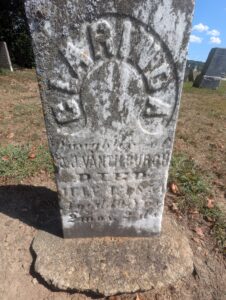
Clarinda’s true parentage is unknown, she is either the daughter of Emmens and an unknown woman with he first initial of J,[1] or Isaac and Jane Adams (his first wife). Emmens is only recorded as being married to Margaret Hiles, born in 1826. Isaac is recorded as being married to Jane Adams until her death in 1845. We know she gave birth to Elizabeth as Elizabeth has her parents on her death record.[2] Emmens dies in 1847, and his widow Margaret marries Isaac in 1849, they have one son together named Emmons in honor of his uncle. Clarinda’s headstone states she is the daughter of a nearly illegible letter & J. A researcher in 1994, James Jacobs, believed the letter was an E, and claimed that she was the daughter of Emmens and an unknown J. With modern resources we have gained new records such as the marriage of Jane and Isaac but may have lost some of the legibility of the headstone that may have been present 20 years ago. All this being said, it means that either Clarinda is an orphan taken in by her uncle and stepmother, or she has lost her mother and is being raised by a father and stepmother who is only 15 years her senior. We do not know if Clarinda was born blind or if it came later in life. She is recorded as idiotic and prone to seizures.[3]

The next important figure to our narrative is Charles Steingraver. Charles Steingraver was born in Germany in 1815. It is unknown when he immigrated to America and lived with his relative Rosan who was likely his wife as the census lists her as being from Ohio. Charles worked as a farm hand for the Vantilburg family. We know Charles spoke German fluently and it is unclear how much English he spoke. The only other family who shares the Steingraver name that is anywhere nearby at the time lived in Hancock Ohio.

The morning of the fourth of July Isaac and Margaret prepared to take their children to a celebration at the Sabbath School in Perrysburg for the day. Clarinda remained at home under the care of Charles who requested they leave her in his care. As a trusted worker they left her with him as traveling with a blind child for a distance can be dangerous at that time. The family then left for their celebration and returned later that day. Upon returning they found Clarinda dead from numerous blunt force injuries. When asking Charles, he claimed that none had come while they were home, furthermore he stated that it must have been a fit or sickness of some sort causing her death. He also claimed that he left to tell a neighbor about the death around 3PM. Clarinda’s body was taken to a coroner where it was determined that the cause of death was likely not accidental and that she was murdered in cold blood, beaten to death likely with the butt of a whip. Charles was arrested at a coroner’s inquest by the Sheriff.

In September a Grand Jury after hearing preliminary evidence brought forth 12 counts against him. 3 counts of 1st degree murder in the commission of a rape, 3 counts of murder in willful, deliberate, and premeditated murder in an attempt to rape, 2 counts of premeditated murder out of malice, 2 counts of 2nd degree murder, and finally 2 counts of manslaughter. This is done to ensure that even if proved innocent of one charge he may still be guilty of another, and due to the inability to be charged for the same crime after being proved innocent without due cause it means many charges are brought forward in one case to ensure thoroughness.

Charles plead not guilty and stood trial in early October. The prosecution was led by B.W. Kellog assisted by Isaac J. Allen, a future journalist and diplomat, and the defense was led by John S. Fulton, and former congressman and future Ohio Supreme Court Justice, Jacob Brinkerhoff. In court Charles was reported as firm and displaying little to no emotion and was apparently indifferent to his situation.  Despite a talented defense, Charles was found guilty after 2 days of trial. He requested a retrial, the reason for which is not recorded, and was immediately denied. He was placed in custody of the Sheriff until he would be executed by hanging on January 30th at noon the following year.

Charles was held in the old stone jail where sheriff Isaac Gates also lived. Sheriff gates had two sons, and it is reported that while imprisoned Charles was given a knife and wood and he whittled small carvings for the boys and was a model prisoner.[4] Only one incident of malice was recorded of his time in the jail. He was slipped a bottle of whiskey and pounced on a fellow prisoner and attacked him.[5]

Upon the date of his hanging a gallows had been erected and somewhere around 10,000 people had assembled to see the gruesome spectacle. Precisely at noon Charles was led from his cell to the gallows wearing white escorted by the Sheriff and 5 ministers, 2 Methodist, and 3 German. He walked to the dead march with unwavering step and upon the scaffold he knelt and listened to numerous prayers in English and German. He submitted to having his arms bound and head covered with a black hood calmly. The Sheriff asked him one last time of his innocence and he responded resolutely “I am Innocent!” which were his final words before he was hanged until dead at 1:15. After half an hour he was taken down and pronounced dead and then buried in an unmarked grave in the Ashland Cemetery.

Clarinda is buried in the Orange/Nankin Cemetery just two graves away from Emmens, they are the only Vantilburgs buried there. Jane is buried in the Lucas Cemetery in Lattasburg, Wayne County. After the hanging, Margaret moved to Hancock along with the children. She married John Travis and is buried in the McComb Cemetery in Hancock Co. It is unknown what happened to Isaac and Rosan.

It would seem that justice was served, but without being there and without a record from the court we cannot know for certain what really happened to Clarinda and who is truly to blame. All we have left now is stories written in the annals of Ashland’s history, and sadly Clarinda is often the footnote with the hanging and Charles as the focus. We do not know much about who she really was, did she like to play with animals on the farm, did she feel loved and cared for by her family? Clarinda’s life was fraught with hardship and even then, her death was all too soon, and it is all we can do to hope that she knew some kindness in her life.

[1] James Wilbur Jacobs, A Murder Mystery in the Middle of my Genealogical Research, The Pastfinder, Feb 1994

[2] “Ohio, United States records,” images, FamilySearch (https://www.familysearch.org/ark:/61903/3:1:33S7-9PJR-212?view=explore : Oct 29, 2025), image 575 of 3041; Ohio Historical Society (Columbus, Ohio).

Image Group Number: 004021034

[3] Floyd Mansfield, Clerk of Courts hand-written notes, “The Steingraver Case.” Ashland County Historical Society Special Collection and Archives.

[4] Betty Plank, County’s Heritage. Ashland County Historical Society Special Collection and Archives

[5] Floyd Mansfield, Clerk of Courts hand-written notes, “The Steingraver Case.” Ashland County Historical Society Special Collection and Archives.

Ashes to Ashland: The Secret of Savannah


On September 18, 1850, Congress passed the Fugitive Slave Law. This law required northern free states to assist in the capture and return of former slaves.[1] While many places in the north, including here in Ohio, followed this law and assisted in the capture of Freedom Seekers, there were some who helped them find their way to Canada.[2]  Ashland County is often a microcosm of the greater United States’ societal differences, and it is no different when examining the impact of the Underground Railroad. Beginning in earnest in the 1840s, slavery was the hot topic of the day, and it divided the county in noticeable ways. Rival newspapers regularly attacked each other, calling out public figures while also decrying the other as traitors to the nation or traitors to their race.[3] Much like other areas of Ohio and the Midwest, Ashland city residents represented the full spectrum of beliefs from the staunch abolitionist to the just-as-passionate pro-slavery, with others in between. This meant only specific areas of the county were considered ‘fully’ safe havens for Freedom Seekers – one of which was Savannah.[4] Originally settled by Scottish immigrants and migrants from New England, Savannah was once part of the Western Reserve of Connecticut. This extension of Connecticut understandably resulted in many of the settlers’ progressive views on abolition. This clashed heavily with much of the southern areas of Ashland County. These areas were overwhelmingly settled by families with strong ties to Virginia, Pennsylvania, and many other northern and southern states.[5] These settlers hosted strong religious ties that contributed to a split in the Presbyterian Church between those who supported slavery and those who opposed it.

The impact of many Savannah families on the Underground Railroad cannot be understated as they risked their property, reputations, finances, and sometimes even lives in order to help secure the freedom of others. Among these families were the Greggs, Sloneckers, Bentons, and Garretts. They worked together as a community to support each other in their assistance of Freedom Seekers between 1847-1860. While the true number is unknown, scholars estimate there were hundreds of Freedom Seekers who made their way through Savannah on the Underground Railroad – eventually reaching Oberlin and then onto Canada.[6]

During the next few months, we will be writing these stories as a part of the Ashes to Ashland column, telling the forgotten stories of these families and how they helped countless Freedom Seekers.


To learn more about Ohio’s wider impact on the Underground Railroad, you can also explore the Wilbur H. Siebert Underground Railroad Collection available online by the Ohio History Connection: https://www.ohiomemory.org/digital/collection/siebert.


[1] United States Fugitive Slave Law. The Fugitive Slave Law. Hartford, Ct.?: s.n., 185-?. Hartford, 1850. pdf. https://www.loc.gov/item/98101767/ accessed 10 April 2025.

[2] William A Duff, History of North Central Ohio, p. 179

[3] The Ashland Union. (Ashland, OH), Oct. 5, 1859. https://www.loc.gov/item/sn83035173/1859-10-05/ed-1/ accessed 10 April 2025.

[4] William A Duff, History of North Central Ohio, p. 179-181

[5] Ibid., p. 59

[6] Ibid., p. 179-181; Rae Bailey, Old Keys, p. 83-85.

Ashes to Ashland: Ann “Pee Wee” Petrovic

On December 7th, 1941, Pearl Harbor was attacked by the Imperial Japanese Navy, bringing the United States into the Second World War.  At its peak, the U.S. Armed Forces had over 16 million men in the service.  Nearly all of these men were the young and able bodied. An unprecedented side effect from this is where our story begins. During times of war, public morale is essential to maintaining the war effort. An unhappy populous is unwilling to fight or support a war. America’s entertainment industry became threatened by the absence of its young men, particularly in sports.  Sports teams began to resort to alternative methods of maintaining rosters, such as making temporary combinations as seen in the case of the Steagles in Pennsylvania. Football resorted to mergers or playing secondaries, etc. Baseball went a different route, starting the All-American Girls Professional Baseball League (AAGPBL).   

The AAGPBL was founded in 1943 by Phillip K. Wrigley, owner of the Chicago Cubs, who was worried about the MLB losing teams to the draft and enlistments. The AAGPBL was formed by scouting softball players and recruiting into new teams that were managed by men to make it appear more “professional” for audiences. During spring training, the girls were required to go to a “charm school”, after the day of practices, for public image training and etiquette. There were several teams, all local to the Midwest area. They were not able to play in the stadiums of the professional men’s teams due to backlash from some team owners and fans, so played in surrounding areas.  

The second season of play is when our star enters the scene. Ann “Pee Wee” Meyer Petrovic joined the league as one of the youngest players ever signed as a 15-year-old high school freshman at only 5’3 and 100 pounds. She played shortstop for the Kenosha Comets as well as the Minneapolis Millerettes in the 1944 season. In 1945, she switched to the National Girls Baseball League (a sister league to the AAPGBL) to play closer to her home in Chicago. She eventually graduated high school and went to college at Nyack Bible College in Nyak NY, where she met her husband, George. When she got married in 1950, she quit baseball and moved to Ashland with her new family.  

Although she stopped playing baseball, her athletic talents were not left by the wayside. She used them to lead a phenomenal women’s volleyball team for the YWCA. She played for 15 years, bringing home numerous championships and titles. She also played one baseball game for Cresco’s industrial team, but stopped playing after injuring another player with a ball thrown to home plate that hit the player in the chest. In an interview she participated in with Grand Valley State University, she explained her competitive spirit. She was a professional player, and that extended into her drive for other sports in the amateur and recreational leagues and her skill and drive led to a massively successful career in women’s baseball and in local volleyball. After living in Ashland from 1952-1978, and participating in local sports, she eventually moved with her husband and two children to Tucson, Arizona, where she now lives.  

Ann was a pioneer of women’s sports. Circumstance gave her and many other women the opportunity to play, but when those circumstances changed, her athletic career continued. She is a member of the Ashland County Hall of Fame for her accomplishments in pioneering women’s sports. Despite the end of the war in 1945 and the return of many of the men from war, the women’s leagues continued until 1954. The league only began to fall apart with the advent of televised games, the decentralization of management, and lack of talent due to rule changes shifting closer and closer to baseball from softball. Most of the players were experienced with softball and needed training to switch over to baseball and that became too much of an effort to maintain. Despite the end of the league itself, the memory of their efforts and the publicity of the league helped pave the way for women’s sports and women athletes throughout the United States. Professional baseball is just one area where WWII provided many women with more opportunities. 


For more information regarding Ann check out her biography page: 

Ann (Meyer) Petrovic (“Pee Wee”) AAGPBL Profile 

And her oral history:  

Petrovic, Ann (Interview transcript and video), 2010 · Digital Collections (gvsu.edu) 

And to read more on the AAGPBL check out their website full of articles and histories 

AAGPBL Players Association 


Ashes to Ashland: Helen Arnold, A Pioneer Probation Officer

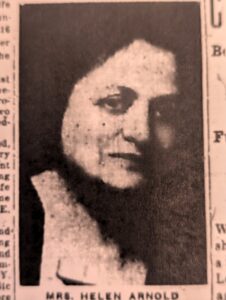
Helen Phillips Arnold was born on the 30th of July in Ashland Ohio in 1875 to Mr. David Allison Phillips and Mary Reep Phillips. She lived out her youth in Ashland, attending Ashland High school and studying for two years at Ashland College. She attended. summer school in Chautauqua, New York before returning to Ashland to teach with the Ashland Public Schools. 

At age 23, Helen married John Edwards Arnold on November 23, 1898. They had one daughter, Lois, but her impact on children was not limited to her own family, or even the children she taught in school. Helen dedicated her entire life to Ashland County as the first probation officer of Ashland. She helped between 200 and 400 children per year for 16 years. She dedicated her life to helping children and their parents get through tough situations. It was a relatively thankless job, paying very little and filled with criticisms and protestation. Despite the trials she faced, she was invited to speak at many events where she always pushed for compassion and understanding. She was also a prominent figure in pushing for public welfare, such as healthcare and nursing for the unfortunate and other programs designed to help Ashlanders.  

Helen served as president of many social programs, including the Woman’s Christian Temperance Union (WCTU). The WCTU was a group of women dedicated to alcohol reform. This was one of many groups who pushed heavily for prohibition. A quote from their second national president Frances E. Willard helps display their ideals; “The mission of the White Ribbon Women is to organize Christian women for the peace and purity, the protection and exaltation of our homes”. Her involvement in the temperance movement may have been related to her social work. As a woman who engaged with many children from broken homes, it is very likely she saw the direct impact of alcoholism in her daily work, and seeing its negative side so regularly may have helped inform her strong support of prohibition. Helen also served as president of the local Delphian Society. The Delphians were dedicated to securing the future through education. She was also a member of the Womens Relief Corps (WRC), whose mission is “to perpetuate the memory of those who sacrificed much and sometimes all in the American Civil War; provide assistance to veterans of all wars and extend needed aid to them and to their widow(er)s and orphans”. All these different organizations paint a picture of who Helen Arnold was and what she believed. She was a devout Christian woman who dedicated her entire life to service. From work to social life, she spent all her time and effort making Ashland a safe, educated, and caring community.  

Helen Arnold died at the age of 60 in 1933, and was survived by her husband, her daughter, two grandchildren, and five sisters.  She had a large family of her own, but rather than focus on just her own family, she made all of Ashland her family, working as a probation officer up until 2 weeks before she died, bedridden from her failing health of two years. Her life was dedicated to Ashland and its children, and as the first probation officer, she pioneered the welfare of the less fortunate in Ashland County.


Ashes to Ashland: Sumner Palmer, A Lost Civil War Veteran

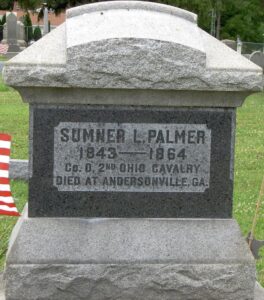
Sumner Levi Palmer was born in Sullivan, Ohio in 1843 to Zurah and Lauretta Palmer. He was held as a prisoner of war by the Confederates at Andersonville Prison in Georgia, where he died in late August/early September of 1864. He was the middle of three children. Joseph was his elder brother by one year and Melvin was his younger brother by 6 years. We have no letters to or from Sumner in our possession, so who he is, what he believed, etc. is left lost to the annals of history. Although much about him is not known from firsthand accounts, we can piece together an idea of what might have motivated him, and use that knowledge to paint a picture of what his life may have been like.  

Sullivan was known as a town of extremist beliefs by most Ashland County residents. It was a hotbed of abolitionist beliefs and according to the Ashland Union Newspaper, to support Abolition was to wish death upon the United States. We know that Joseph joined Company C of the Union Army in 1861 as a young man of around 18 years old. After arriving at Camp Chase, Company C asked collectively to join the 42nd Ohio Infantry after learning it was led by Colonel James Garfield, who raised the unit himself through travelling around and giving speeches. Garfield gave a speech at the Ashland County courthouse just a few months after Joseph joined. Garfield said in his speech, according to his letters, that Ashland is a place filled with those who are “afraid ‘to do good on the sabbath.’”  It is likely that the Palmer family was Presbyterian, like most of Sullivan Township. These highly religious people were staunch abolitionists, but in many cases, may have been opposed to war and violence due to their Christian beliefs. This belief was clearly common enough that a Colonel recruiting in the area thought it to be worth using as a recruiting point. Garfield was a man who was staunchly opposed to slavery, and recruited almost solely on the basis of abolition. This character attracted Palmer and his comrades so strongly as to request him specifically.  

The Palmer brothers did not join at the same time. Joseph joined early and was in the infantry. He fought for much of the war and was discharged with his unit toward the end of the war in September 1864. Sumner joined three years after his brother. Why they did not join at the same time, we do not know for certain. We know Sumner joined the 2nd Ohio Cavalry in 1864, and he is not in the draft registry for the year – meaning his late enlistment was voluntary, and not due to the four drafts conducted from 1863-65. Using this information, we can speculate on how he managed to become interned at Andersonville, where he would die. Why would he join so much later than his brother did, when they were only a year apart in age? The reason Sumner joined is purely up to imagination and some historic context to create potential answers. But overall, we cannot truly know why, but we do know that his decision to join would cost him his life. 

Sumner joined in February of 1864 and would only be in the army for 6 months, but it was during some of the heaviest fighting of the war. The 2nd Cavalry fought alongside the Army of the Potomac during Grant’s Overland Campaign into the South in 1864. The timeline of Sumner’s enlistment means that the first major battle he could have fought in would have been The Battle of the Wilderness. There are only a few battles in which he could have fought. He could have fought in The Battle of Spotsylvania Courthouse, Totopotomoy Creek, and/or Sherridan’s Shenendoah Valley campaign. The specific battle he was likely captured during was The First Battle of Reams Station. This battle took place on June 29th during the so-called “Siege of Petersburg”. It was not a major battle, but there were 600 casualties or captives, some of which were members of the 2nd Ohio, and all of whom are documented as having been interned at Andersonville Prison. This newly constructed prison n the Deep South is known for its poor living conditions and high death rates.  

Andersonville would be Sumners last destination. We do not know when he arrived, but we do know that his stay there was not long. From the evidence we have from those who survived Andersonville, we know that the prisoners were packed like sardines and disease was rampant. In addition, much of the supplies that were intended for prisoner use were withheld from them, leading to starvation and an increase in diseases from poor sleeping and living conditions. It is likely he arrived at Andersonville in July, shortly after the First Battle of Ream’s Station. He is reported as having died on September 16, 1864, by the roster which states his enlistment date as February 24th of the same year.  

We do not know how Sumner died. He is not on the records of the medical clerk or in the burial records of Andersonville, GA. Sumner lived a short and tragic life, but it is not one that is unique to him. Sumner is but one of many soldiers who fought for the Union in the Civil War who are not remembered today. The reasons they fought are forgotten, but that does not mean they are forgotten. Joseph Palmer was mustered out with his Company on September 30, 1864, just mere days after Sumner died. It is unlikely that he knew about his brother’s death. Joseph fought for years, likely in fear for his life hundreds of times, but he made it to the end. How many brothers in arms he lost, we cannot know. What relief he must have felt in surviving the war, or what guilt he may have felt for outliving his comrades, is only known to him and history. Did Joseph think his brother was more likely to make it out than he was? Was he nervous that his brother was involved in the main front of the war, where it was more dangerous? The mind of Joseph was likely consumed by inner turmoil.  

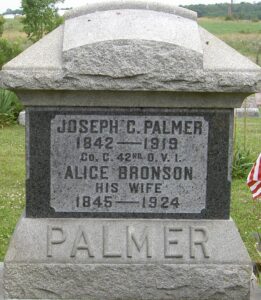
Joseph’s brother Melvin died in 1884 at the age of 35. Joseph died in 1919, and is buried with his wife Alice, beside his parents and near Melvin. The whole family now rests together save one. Sumner’s final place of rest is unknown. He may be buried in an unmarked grave in Andersonville, or he may have died in combat without his body being recovered, and only assumed to have gone to Andersonville with his comrades. Interestingly, in the Andersonville records, there is a F.G. Palmer from Sumners unit listed among those deceased around the time of Sumner’s death. Was it a clerical error? Or another person entirely? Although we cannot know where his body rests, we do know he has not been forgotten. Sumner’s year of birth and death are engraved on the back of Joseph’s headstone in the Southview Cemetery in Sullivan.