
The Twisting Histories of the Savannah Presbyterian Churches
There is a unique experience that can be seen when travelling through America, regardless of state, location, or size; other than a fast-food chain and a gas station, the most constant building to find is a church. America is 11th in the number of churches per capita and has roughly 350,000 churches. In many cases, religion was a driving force behind the creation and unification of communities. In other cases, religion has served in the inverse role, pushing communities apart. Both were the case in Savannah, OH, during the mid-19th century. The prime case of this can be seen in the Presbyterian Church.
The Presbyterian church is a Calvinist denomination that originated in Scotland and has been prominent there for centuries, so much so that the national religion of Scotland, the Church of Scotland, is Presbyterian. This impacted Savannah as a large amount of its population in the 19th century was of Scottish or Irish descent (Ireland also has a relatively large population of Presbyterians; however, many of them are Scotch-Irish). The United States 1860 census lists Savannah as having roughly 1,200 residents. In this tiny community, there were at least 125 immigrants from Scotland or Ireland living there, and this does not include their children born here or any others who were born in the U.S. but have Scotch-Irish Descent. This means at least 10% population at minimum was Scottish or Irish. These immigrants and their families were almost entirely Presbyterian; however, this did not make them unified all the time.
The mid-19th century in America is the time in which, as Lincoln said, “we are engaged in a great civil war, testing whether that nation, or any nation so conceived and so dedicated, can long endure.”[2] Commonly the Civil War period is focused on the division seen in the territories, border states, and the North vs. South divide. The fight over slavey did not only divide on geographic lines, it also caused divides in families and communities, no matter how small. Savannah, Ohio, pulls both the threads of deep religious conviction and staunch beliefs regarding slavery into one strand that brought their community together and ripped it apart.
At one point in time, Savannah had four different Presbyterian churches, but how these four came to be and where they came to be is a story that walks alongside the struggles of the country itself. In the early days of its founding, Savannah had two Presbyterian churches, the Old School Presbyterian church (OSP) and the Associate Reformed Presbyterians (ARP). The OSP church first started meeting in the homes of different families until they eventually built a meeting house in 1835. Just before this, the ARP also began to form and worship in the same way, eventually moving to an outdoor tent used by other denominations as well, until the ARP built their own building in 1834. These two would walk alongside each other with different congregations, mostly separate due to the theological disputes between the sub-denominations to which they each belong.
The third church would come in around 1855 and is known as the Associate Presbyterian church, or Assoc. P. This church would have a smaller number of congregants than the other two; however, it remained strong for some time, and they met in the old ARP building. This church has existed since 1837; however, it did not officially form until ’55. The fourth and final church of the time was the Free Presbyterian Church, or Free Church, which was formed in 1851 by 13 members of the OSP who left over an argument that would shape each of the 4 churches in Savannah. This argument was, of course, slavery.
The OSP first began its heated arguments over slavery in the congregation in 1842. A meeting was called, and the two issues on the docket were “Is the Colonization Society worthy of the patronage of the American people?” and “Is the Anti-slavery Society worthy of the patronage of the American people?” Rev. Andrew Scott reported in his Sermon “The History of the Presbyterian Church of Savannah, Ohio: A Discourse,” which was later printed, that the debate lasted for 3 days. These debates tore the church apart and led to feuds that would never heal within their lifetime. [3] Out of these debates, their preacher, Mr. Shearer, announced he would resign due to the difference between himself and the congregation regarding these issues. After many attempts to have him stay, in the end, he left the church without a pastor. The church tried many times to gain a regular minister, but each minister either did not suit the abolitionists or did not suit the colonists. After months of effort they eventually settled on having a statement expressing their desires, it reads “Resolved, that we, the church of Clear Creek, feel it to be the duty of our Minister to preach against slavery as a sin on all suitable and proper occasions, and that he treat it in common with all other sins, just as the Bible treats it.”[4] This statement eventually led many of the Colonizers to leave the church. They were not the only ones to leave the church, however, as the years went on and the higher courts of the OSP were not as strong on slavery as many in Clear Creek would like, 13 members left and formed themselves into the Free Presbyterian Church. The OSP would not settle its internal arguments with the leaving of the 13 Free Church founders. Later in 1851, just a year after the split, they argued once again about slavery, concluding that most of the church was anti-slavery, but not a majority were abolitionists. The church agreed to not justify slavery regardless of source; however, it would not agree to only accept a minister who used his talents to exclude and denounce slavery and its supporters entirely. Many of the staunch abolitionists would find their way to the Free Church as time went on.
The Assoc. P Church, while only becoming official in 1855, was immediately embroiled in arguments over slavery. Not much is clear in written documents, other than one case of a member requesting a letter of dismissal due to his accusations that the church was pro slavery in practice but antislavery in profession, as it welcomed pro slavery advocates. The ARP Church had the same struggles with slavery as the other two (OSP & Assoc P), following almost the exact pattern that the OSP endured. The ARP church first began to split in 1851 when its preacher left after failing to put together a group to travel and settle in Oregon, in addition to slavery tensions boiling during the same time. Eventually, in 1854, 25 members left the ARP, and many joined the Free Church.
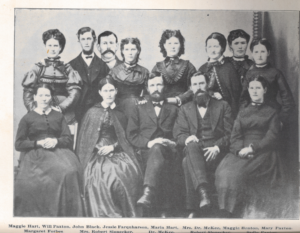
The Free Presbyterian church was made from members of all three churches who left in search of a church that would appropriately and accurately confront slavery as an unjustifiable and unacceptable evil. The church itself did not have any known arguments about slavery, as they were all of one mind. The Free Church was made up of families who attended the other three churches and, in many cases, had family members who still attended them. One such example is the Slonecker family. Jared Slonecker was one of the first elders of the Assoc. P church when it officially formed in 55. However, his son Robert Slonecker was a trustee of the Free church. This is a very strange occurrence for the time, as most families all attended the same church, and to split from family and faith shows just how strong a force slavery was. In addition to this tension, it is known that Maggie Slonecker, the daughter of Jared and sister of Robert, helped on the Underground Railroad. We know further that Maggie helped Mary Benton, who was a part of the Benton family, who were also notable members of the Free Presbyterian Church. Her sister Barbara Benton Garrett married Ezra Garrett, who was a conductor on the Underground Railroad and was also likely a member of the Free Church.
These churches all existed through the Civil War, separated by slavery and united by it. After the war ended, they eventually would reunite into two churches, the United Presbyterian and the Old School Presbyterian. The Free Presbyterian Church disorganized in 1867 as slavery was abolished and their unifying cause was accomplished; they rejoined mostly with the ARP. The Assoc. P and ARP joined in 1858 when their higher courts unified however the tensions of slavery did not disappear with this reunification and the Savannah United Presbyterian which had be unified for a short time split into east and west for years until they finally came back together again in 1868. [5] This year marks the end of the years of division over slavery. With slavery having ended, all the members of the different churches eventually reunited; however, their sentiments on slavery and the animosity that was created at this time would not leave for some time. Despite slavery not existing in Ohio, and there being almost no battles fought here either, Savannah shows that it was not spared from the division. The People of Savannah were so steadfast in their moral convictions that it was not enough to simply disagree with slavery; for many of them, it was essential to have actions that backed up the words.
A Timeline of events:
1821 – First accounts of Presbyterians practicing in Savannah
1831 – ARP Church officially founded
1833 – OSP Church officially founded
1837 – AP Church begins to meet
1851 – 13 Members leave the OSP to found the Free Church
1854 – 25 members leave ARP and many join Free Church
1855 – AP Church becomes official
1858 – ARP and AP unite and become the United Presbyterian
1860 – The United Church splits into east and west congregations, with the ARP and AP folks each having their own side
1861 – Civil War begins
1865 – Civil War ends
1867 – Free Church Disbands with the end of slavery
1868 – AP and ARP or East and West reunite into one United Presbyterian Church
[1] Home | U.S. Religion Census | Religious Statistics & Demographics
[2] Lincoln, Abraham, Pres. U. S. Gettysburg address delivered at Gettysburg, Pa., Nov. 19th. n. p. n. d. Pdf. https://www.loc.gov/item/rbpe.24404500/.
[3] Scott, Alexander, Rev. Presbyterian Church of Savannah (OSP), History of the Presbyterian church of Savannah, Ohio: A Discourse, Preached at Savannah, OH. Apr. 3, 1870.
[4] Scott, Alexander, Rev. Presbyterian Church of Savannah (OSP), History of the Presbyterian church of Savannah, Ohio: A Discourse, Preached at Savannah, OH. Apr. 3, 1870.
[5] Garges, W.L. Rev. United Presbyterian Church of Savannah, Ohio. History of the United Presbyterian Church, Savannah, Ohio, 1831-1906, Savannah, Ashland County, Ohio. June 6, 1906