
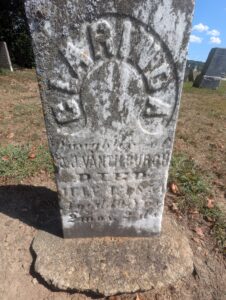
The sun shone brightly on a hot summer day in 1851, Independence Day celebrations of all sorts could be heard with cheers and reveling that filled the nation. However, this day of celebration would not end with joy for one Ashland County family. Clarinda Vantilburg, a blind 10-year-old girl, was murdered while her family was away. To understand what happened to Clarinda some questions must be answered: Who is Clarinda? Where does she come from? Who killed her and why? And what happened to her killer?
The first Vantilburg to arrive in America Jan Teunissen Van Tilburgh, a Dutchman by birth. His son was the first of the Vantilburgs to be born in the “new world” in 1664. After 5 generations, the Vantilburgs found themselves in Ohio with Henry Vincent Vantilburg (Henry V) moving to Jefferson County and eventually made their way to Ashland County. While he was married twice, Henry V.’s two sons by his first wife, Isaac and Emmens, play an important role in the telling of Clarinda’s story – neither of them happy.
Clarinda’s true parentage is unknown, she is either the daughter of Emmens and an unknown woman with he first initial of J,[1] or Isaac and Jane Adams (his first wife). Emmens is only recorded as being married to Margaret Hiles, born in 1826. Isaac is recorded as being married to Jane Adams until her death in 1845. We know she gave birth to Elizabeth as Elizabeth has her parents on her death record.[2] Emmens dies in 1847, and his widow Margaret marries Isaac in 1849, they have one son together named Emmons in honor of his uncle. Clarinda’s headstone states she is the daughter of a nearly illegible letter & J. A researcher in 1994, James Jacobs, believed the letter was an E, and claimed that she was the daughter of Emmens and an unknown J. With modern resources we have gained new records such as the marriage of Jane and Isaac but may have lost some of the legibility of the headstone that may have been present 20 years ago. All this being said, it means that either Clarinda is an orphan taken in by her uncle and stepmother, or she has lost her mother and is being raised by a father and stepmother who is only 15 years her senior. We do not know if Clarinda was born blind or if it came later in life. She is recorded as idiotic and prone to seizures.[3]
The next important figure to our narrative is Charles Steingraver. Charles Steingraver was born in Germany in 1815. It is unknown when he immigrated to America and lived with his relative Rosan who was likely his wife as the census lists her as being from Ohio. Charles worked as a farm hand for the Vantilburg family. We know Charles spoke German fluently and it is unclear how much English he spoke. The only other family who shares the Steingraver name that is anywhere nearby at the time lived in Hancock Ohio.
The morning of the fourth of July Isaac and Margaret prepared to take their children to a celebration at the Sabbath School in Perrysburg for the day. Clarinda remained at home under the care of Charles who requested they leave her in his care. As a trusted worker they left her with him as traveling with a blind child for a distance can be dangerous at that time. The family then left for their celebration and returned later that day. Upon returning they found Clarinda dead from numerous blunt force injuries. When asking Charles, he claimed that none had come while they were home, furthermore he stated that it must have been a fit or sickness of some sort causing her death. He also claimed that he left to tell a neighbor about the death around 3PM. Clarinda’s body was taken to a coroner where it was determined that the cause of death was likely not accidental and that she was murdered in cold blood, beaten to death likely with the butt of a whip. Charles was arrested at a coroner’s inquest by the Sheriff.
In September a Grand Jury after hearing preliminary evidence brought forth 12 counts against him. 3 counts of 1st degree murder in the commission of a rape, 3 counts of murder in willful, deliberate, and premeditated murder in an attempt to rape, 2 counts of premeditated murder out of malice, 2 counts of 2nd degree murder, and finally 2 counts of manslaughter. This is done to ensure that even if proved innocent of one charge he may still be guilty of another, and due to the inability to be charged for the same crime after being proved innocent without due cause it means many charges are brought forward in one case to ensure thoroughness.
Charles plead not guilty and stood trial in early October. The prosecution was led by B.W. Kellog assisted by Isaac J. Allen, a future journalist and diplomat, and the defense was led by John S. Fulton, and former congressman and future Ohio Supreme Court Justice, Jacob Brinkerhoff. In court Charles was reported as firm and displaying little to no emotion and was apparently indifferent to his situation. Despite a talented defense, Charles was found guilty after 2 days of trial. He requested a retrial, the reason for which is not recorded, and was immediately denied. He was placed in custody of the Sheriff until he would be executed by hanging on January 30th at noon the following year.
Charles was held in the old stone jail where sheriff Isaac Gates also lived. Sheriff gates had two sons, and it is reported that while imprisoned Charles was given a knife and wood and he whittled small carvings for the boys and was a model prisoner.[4] Only one incident of malice was recorded of his time in the jail. He was slipped a bottle of whiskey and pounced on a fellow prisoner and attacked him.[5]
Upon the date of his hanging a gallows had been erected and somewhere around 10,000 people had assembled to see the gruesome spectacle. Precisely at noon Charles was led from his cell to the gallows wearing white escorted by the Sheriff and 5 ministers, 2 Methodist, and 3 German. He walked to the dead march with unwavering step and upon the scaffold he knelt and listened to numerous prayers in English and German. He submitted to having his arms bound and head covered with a black hood calmly. The Sheriff asked him one last time of his innocence and he responded resolutely “I am Innocent!” which were his final words before he was hanged until dead at 1:15. After half an hour he was taken down and pronounced dead and then buried in an unmarked grave in the Ashland Cemetery.
Clarinda is buried in the Orange/Nankin Cemetery just two graves away from Emmens, they are the only Vantilburgs buried there. Jane is buried in the Lucas Cemetery in Lattasburg, Wayne County. After the hanging, Margaret moved to Hancock along with the children. She married John Travis and is buried in the McComb Cemetery in Hancock Co. It is unknown what happened to Isaac and Rosan.
It would seem that justice was served, but without being there and without a record from the court we cannot know for certain what really happened to Clarinda and who is truly to blame. All we have left now is stories written in the annals of Ashland’s history, and sadly Clarinda is often the footnote with the hanging and Charles as the focus. We do not know much about who she really was, did she like to play with animals on the farm, did she feel loved and cared for by her family? Clarinda’s life was fraught with hardship and even then, her death was all too soon, and it is all we can do to hope that she knew some kindness in her life.
[1] James Wilbur Jacobs, A Murder Mystery in the Middle of my Genealogical Research, The Pastfinder, Feb 1994
[2] “Ohio, United States records,” images, FamilySearch (https://www.familysearch.org/ark:/61903/3:1:33S7-9PJR-212?view=explore : Oct 29, 2025), image 575 of 3041; Ohio Historical Society (Columbus, Ohio).
Image Group Number: 004021034
[3] Floyd Mansfield, Clerk of Courts hand-written notes, “The Steingraver Case.” Ashland County Historical Society Special Collection and Archives.
[4] Betty Plank, County’s Heritage. Ashland County Historical Society Special Collection and Archives
[5] Floyd Mansfield, Clerk of Courts hand-written notes, “The Steingraver Case.” Ashland County Historical Society Special Collection and Archives.